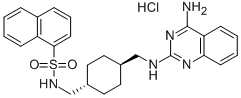
CGP 71683 is an antagonist of neuropeptide Y (NPY) receptor Y5 (IC50 = 1.4 nM in a radioligand binding assay). It is selective for Y5 over Y1, Y2, and Y4 receptors (IC50s = 2,765, 7,187, and 5,637 nM, respectively). It inhibits NPY-induced increases in BT-549 cell growth and MDA-MB-231 cell migration when used at a concentration of 0.25 μM. CGP 71683 (10 mg/kg, i.p.) inhibits increases in food intake induced by intracerebroventricular administration of NPY in rats.
CGP71683 hydrochloride is a competitive neuropeptide Y5 receptor antagonist with a Ki of 1.3 nM, and shows no obvious activity at Y1 receptor (Ki, >4000 nM) and Y2 receptor (Ki, 200 nM) in cell membranes.
Extremely selective, non-peptide NPY Y 5 receptor antagonist. Displays > 1000-fold selectivity over Y 1 , Y 2 and Y 4 receptors; IC 50 values are 1.4, 2765, 7187 and 5637 nM at cloned rat Y 5 , Y 1 , Y 2 and Y 4 receptors respectively. Potently inhibits NPY-induced food intake following i.p. administration in diabetic, free-feeding and fasted rats.
CGP71683 (15 nmol/rat, icv, twice daily) shows anorexigenic effect, reducing food intake and bady weight of fed rats. CGP71683 causes 3-times higher serum total T4 and 37% increase in free T4 in the fasted rats than in the fasted controls rats[2].
[1] Lecklin A, et al. Receptor subtypes Y1 and Y5 mediate neuropeptide Y induced feeding in the guinea-pig. Br J Pharmacol. 2002 Apr;135(8):2029-37. DOI:
10.1038/sj.bjp.0704667[2] Costa-e-Sousa RH, et al. Central NPY-Y5 receptors activation plays a major role in fasting-induced pituitary-thyroid axis suppression in adult rat. Regul Pept. 2011 Nov 10;171(1-3):43-7. DOI:
10.1016/j.regpep.2011.07.001