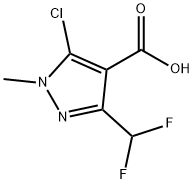
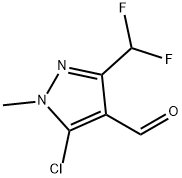
In a 500 mL three-necked flask, 6.0 g (31 mmol) of 5-chloro-3-(difluoromethyl)-1-methyl-1H-pyrazole-4-carbaldehyde was dissolved in 30 mL of toluene. To this solution was slowly added 2.4 g (62 mmol) of sodium hydroxide dissolved in 6 mL of water, followed by the dropwise addition of 103 mL of a 30% aqueous hydrogen peroxide solution at a temperature controlled below 37 °C. The reaction mixture was stirred at 50°C for 7 hours. After completion of the reaction, it was cooled to room temperature and the organic and aqueous phases were separated. The organic phase was extracted with 100 mL of water and the aqueous phase was combined. The combined aqueous phases were acidified to pH 2 with dilute aqueous hydrochloric acid and a white precipitate was precipitated. The precipitate was collected by filtration, washed twice with 20 mL of water and dried to give 3.2 g of 5-chloro-3-(difluoromethyl)-1-methyl-1H-pyrazole-4-carboxylic acid as a white solid. The product was characterized by 1H NMR (400 MHz, DMSO-d6): δ 3.78 (s, 3H), 7.12 (t, 1H, JHF = 53.60 Hz), 13.19 (s, 1H); IR (KBr) showed: 1688 cm-1 (C=O stretching vibration), 2200-3200 cm-1 broad peak (hydrogen bonding vibration).