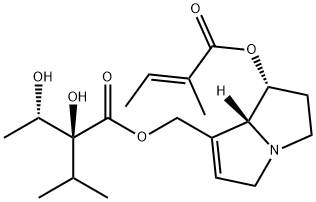
This pyrrolizidine alkaloid occurs in the roots of Symphytum officinale Linn.
and is difficult to crystallize. The above structure has been proposed on the basis
of chemical degradation and spectroscopic evidence.
Symphytine is a pyrrolizidine alkaloid isolated from Symphytum officinale and has carcinogenicity[1].
ChEBI: A but-2-enoate ester obtained by formal condensation of the carboxy group of (2E)-2-methylbut-2-enoic acid with the 1-hydroxy group of (1R,7aR)-7-({[(2S,3S)-2,3-dihydroxy-
-isopropylbutanoyl]oxy}methyl)-2,3,5,7a-tetrahydro-1H-pyrrolizin-1-ol.
Symphytine (intraperitoneal injection; 13 mg/kg; 330 days) leads to survival for more than 330 days after the start of injections. Four of 20 rats (20%) had liver tumors: three has hemangioendothelial sarcoma and 1 has liver cell adenoma[1].
| Animal Model: | Male inbred ACI rats[1] |
| Dosage: | 13 mg/kg |
| Administration: | Intraperitoneal injection; 330 days |
| Result: | Led to hepatic tumor in rats. |
Furuya, Araki., Chem. Pharm. Bull. (Tokyo), 16,2512 (1968)
Structure:
Furuya, Hikichi., Phytochem., 10, 2217 (1971)