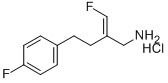
Mofegiline hydrochloride (MDL72974A) (0.1-2.5 mg/kg; p.o.; single dose) inhibits MAO-B activity external vivo in rat model and (1.25 mg/kg; i.p.; 18 hours prior to MPTP treatment) exerts its ability to block MPTP neurotoxicity in mice model[1].
| Animal Model: | Male Sprague-Dawley rats (150-400 g)[1] |
| Dosage: | Group 1: 0.1-2.5 mg/kg; Group 2: 0.05-5 mg/kg |
| Administration: | Oral gavage; single dose for group 1, as for group 2, once daily for 14 days |
| Result: | Showed the inhibition effect on rat brain MAO-A and MAO-B with EC50s of 8 mg/kg and 0.18 mg/kg, respectively, in group 1.
Resulted more potent efficacy on MAO-A inhibition in a daily dosed-manner (group 2) than single dose (group 1) manner, indicating a long half-life of Mofegiline hydrochloride. |
| Animal Model: | Mate SwissWebster (CF-W) mice (25-30 g)[1] |
| Dosage: | 1.25 mg/kg |
| Administration: | Intraperitoneal injection; 18 hours prior to administration of MPTP (20 mg/kg; i.p.; 4 times for two-hourly intervals, for 8 days) |
| Result: | Rescued MPTP-induced decreases in striatal levels of dopamine (DA), dihydroxyphenylacetic acid (DOPAC) and homovanillic acid (HVA) in mice. |
| Animal Model: | Male Sprague-Dawley rats (150-400 g) injected with Tyramine (HY-W007606) (1.25-80 μg/kg; i.v.)[1] |
| Dosage: | Group 1: 1.8, 9 mg/kg; Group 2: 0.1, 1 mg/kg |
| Administration: | Oral gavage; single dose for group 1, as for group 2, once daily for 14 days |
| Result: | Did not significantly potentiate the cardiovascular effects of intraduodenally administered Tyramine (HY-W007606) in anaesthetised rats. |