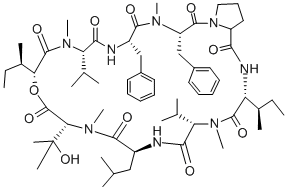
The polyethylene glycol-modified basifenacin has a strong solubility ability, while the spatial site-blocking effect of macromolecules is produced due to the barrier formed by polyethylene glycol around basifenacin, which reduces the enzymatic degradation of basifenacin in vivo, prolongs its half-life, avoids the rapid metabolic elimination of basifenacin in the kidney, and improves its therapeutic efficacy. The mPEG-C(=O)-Basifungin was prepared as follows:
1. Preparation of mPEG-SC samples
Poly(ethylene glycol) PEG of different molecular weights was dissolved in appropriate amount of dichloromethane, 1.1 eq. of DSC (disuccinimidyl carbonate), 2 eq. of DIEA (diisopropylethyl amine), 0.2 eq. of DMAP (N,N-dimethylaminopyridine) was added, the reaction was carried out for 8h at temperature control of 60C, concentrated, and precipitated by isopropyl ether, and the PEG-SC samples were obtained respectively with different molecular weights. Succinimide activation product PEG-SC.
2. Sample preparation of mPEG-C(=O)-basifenacin
The poly(ethylene glycol)-modified basifenacin of the present invention comprises the steps of adding phosphate buffer to the basifenacin solution, adjusting its pH to 6.0-9.0, and then adding mPEG-SC for a reaction at 5-40C, preferably 25C, for a reaction time of 2-6 hours, preferably 4 hours. The reaction mixture is separated by chromatography, and the mobile phase is sodium chloride acetate-containing buffer, after chromatographic separation, concentrated, and lyophilized to obtain different molecular weights of polyethylene glycol-modified basifenacin; said basifenacin solution is an aqueous solution of 1 mg/mL by weight. The present polyethylene glycol-modified Basifenacin can be prepared as an antifungal drug.