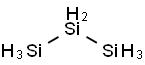
Trisilane is a trace product of the reaction between SiH₂ and HCl, a reaction that requires an infrared laser. The laser is positioned on a stainless steel cylindrical cell perpendicular to the mass spectrometer's laser. Trisilane can also be prepared using the Schlesinger method, which involves reacting lithium aluminum hydride with octachloroTrisilane in n-butyl ether. Furthermore, Pauly, Purnell, and Walsh demonstrated in the 1960s that Trisilane thermally decomposes at high temperatures into silane and ethylsilane.
Trisilane is a flammable and toxic liquid at room temperature and pressure. Its main uses are in the manufacture of semiconductor silicon films and amorphous silicon.
Colorless liquid; density 0.743 g/mL at 0°C; freezes at –117.4°C; boils at 52.9°C; vapor density 4.15 g/L at atmospheric pressure; decomposes in water; decomposes in carbon tetrachloride.
Silicon forms a series of hydrides known as silanes, formula SinH2n+2, where n is the number of silicon atoms in the molecule. This general formula for the silicon hydrides is similar to the CnH2n+2 for the alkane class of hydrocarbons.
colorless liquid; enthalpy of vaporization 28.38 kJ/mol; vapor pressure at (0°C) 95mm Hg; critical temp 189°C; reacts vigorously with CCl4 and CHCl3 [CIC73] [CRC10] [MER06]
Explodes on contact with air, reacts violently
with carbon tetrachloride and chloroform.