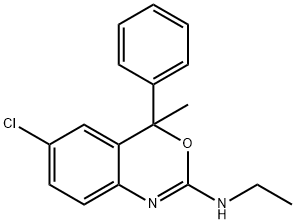
Etifoxine is a positive allosteric modulator of α1β2γ2 and α1β3γ2 subunit-containing GABAA receptors.1 It selectively increases GABA-induced currents in X. laevis oocytes expressing α1β2γ2 or α1β3γ2 over α1β1γ2 subunit-containing receptors at 20 µM. Etifoxine inhibits binding of the GABAA receptor agonist muscimol in rat corticol membranes with a Kd value of 23 nM in a radioligand binding assay.2 It increases NGF-induced neurite outgrowth in PC12 cells when used at a concentration of 20 µM.3 Etifoxine (12.5 mg/kg, i.p.) increases the percentage of time spent in the open arms of the elevated plus maze in high-anxiety BALB/cByJ, but not C57BL/6, mice, indicating anxiolytic-like activity.4 It increases the seizure threshold in a mouse model of seizures induced by picrotoxin (Item No. 20771) with a minimum effective dose (MED) of 75 mg/kg.2 Etifoxine (50 mg/kg, i.p.) also increases the paw withdrawal threshold on the ipsilateral side in a rat model of rheumatoid arthritis induced by complete Freund's adjuvant.5WARNING This product is not for human or veterinary use.
Circupon,Troponwerke,W. Germany
ChEBI: Etifoxine is a benzoxazine.
30 parts of 1-(3'-hydroxyphenyl)-2-(N-benzylaminomethyl)-ethan-1-one are
mixed with 100 parts of pyridine and 30 parts of pivalic anhydride and
dissolved while warming. After heating for 1 hour under reflux, the acylation
is complete. After concentrating the reaction solution, the product is
precipitated from acetone/ether. Yield: 96.4% of 1-(3'-pivaloyloxyphenyl)-2-
(N-benzylaminomethyl)-ethan-1-one.
3 parts of palladium/charcoal (10% strength) are prehydrogenated in water,
thereafter 10 parts of 1-(3'-pivaloyloxyphenyl)-2-(N-benzylaminoethyl)-ethan-
1-one, dissolved in a 10-fold amount of water, are added dropwise at room
temperature and hydrogenation is carried out until 1 mol of hydrogen has
been taken up. After filtering off the catalyst, a further 3 parts of
palladium/charcoal are added and hydrogenation is carried out until a further
mol of hydrogen has been taken up. The catalyst is separated off and after
removal of the solvent the hydrogenation product is reprecipitated from
acetone/petroleum ether and from methanol/ether until it is pure according to
thin layer chromatography. Yield: 38.8% of 1-(3'-pivaloyloxyphenyl)-2-
ethylaminoethanol-1 hydroxide, melting point 208°C to 209°C.