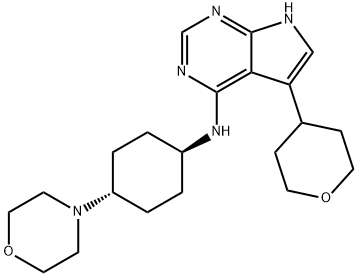
AZ1495 (compound 28) (oral, daily, 12.5 mg/kg) leds to tumor regression combination with ibrutinib in an ABC-DLBCL mouse model (OCI-LY10 cells)[1].
AZ1495 (iv., 2 mg/kg and oral, 5mg/kg) is characterized by high clearance (Cl) in rat (75 mL/min/kg) and moderate predictions based on hepatocyte data (Clint 15 μl/min/106 cells, predicted clearance 42 mL/min/kg) with low bioavailability consistent with a high first pass effect[1].
AZ1495 (iv., 1 mg/kg) has low the amount of active renal secretion occurring in the dog[1].
| Animal Model: | CB.17 SCID mice[1] |
| Dosage: | 12.5 mg/kg |
| Administration: | oral, daily, 12.5 mg/kg |
| Result: | Had modest anti-tumor activity as single agents but a combination ofibrutinib led to tumor regression and is well tolerated. |
| Animal Model: | rat[1] |
| Dosage: | 2 mg/kg, 5mg/kg |
| Administration: | iv., 2 mg/kg and oral, 5mg/kg |
| Result: | | Species | Dose (mg/kg) | Cl (mL/min/kg) | Vss(L/kg) | PO halflife (h) | IV halflife (h) | Fabs (%) | F (%) | | Rat | 2,5 | 75 | 2.1 | 2.0 | 0.8 | 100 | 28 | | Dog | 1 | 29 | 3.0 | - | 3.3 | - | - | |
|
| Animal Model: | dog[1] |
| Dosage: | 1 mg/kg |
| Administration: | iv., 1 mg/kg |
| Result: | | Species | Dose (mg/kg) | Cl (mL/min/kg) | Vss(L/kg) | PO halflife (h) | IV halflife (h) | Fabs (%) | F (%) | | Rat | 2,5 | 75 | 2.1 | 2.0 | 0.8 | 100 | 28 | | Dog | 1 | 29 | 3.0 | - | 3.3 | - | - | |
|