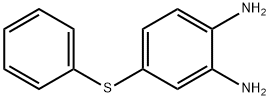
4-(Phenylthio)-1,2-benzenediamine is used in the synthesis of bis(2-chloroethyl)aminophosphoryl-containing compounds which are potential anticancer agents. It is also used in the synthesis of 2-substituted-2,3-dihyrdro-5-thiophenoxy-1H-1,3,2-benzodiazaphosphole 2-oxides which exhibit antimicrobial activity.
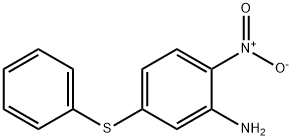
General procedure for the synthesis of 4-(phenylthio)benzene-1,2-diamine from 2-nitro-5-phenylmercaptoaniline: 2-nitro-5-phenylmercaptoaniline (36.9 g) and 4 times its weight of ethanol, followed by 0.1 times the weight of platinum-carbon catalyst for 2-nitro-5-phenylmercaptoaniline, were added to a 500 mL four-necked flask equipped with thermometer and stirring device. The hydrogenation reaction was initiated with stirring and heated to 70-90°C under hydrogen atmosphere while pressurized to 1.0-2.0 MPa for 8 hours. Upon completion of the reaction, the platinum carbon catalyst was removed by filtration, followed by evaporation to remove ethanol to afford 4-(phenylthio)benzene-1,2-diamine (21.2 g), which can be used directly in the next step of the reaction.
[1] Archiv der Pharmazie, 1983, vol. 316, # 7, p. 638 - 638
[2] Journal of Heterocyclic Chemistry, 2004, vol. 41, # 2, p. 273 - 276
[3] Patent: CN103242238, 2016, B. Location in patent: Paragraph 0039; 0040