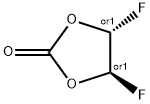
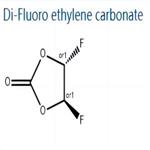
As the analog of fluoroethylene carbonate, difluoroethylene carbonate (DFEC) is a promising electrolyte additive for stabilizing the electrolyteelectrode interphase in LMBs. DFEC could be a multifunctional electrolyte additive for a stable high-voltage LMB system. At first, DFEC exhibits a low LUMO level, which can decompose into a LiFrich SEI layer, which can govern the Li+ -ion flux and suppress the growth of lithium dendrite. Furthermore, DFEC also has a good performance for forming a thin but stable CEI layer on the surface of the cathode, which can significantly reduce the side reaction between the electrolyte and the cathode. Therefore, Li||LiNi0.8Mn0.1Co0.1O2 (NMC811) full cells with 5% DFEC addition presents a very stable cycling performance[1].
Fluorine vinyl carbonate was added to a reaction bottle in a nitrogen atmosphere, then a first organic solvent was added, and then a chlorinated reagent was added to carry out a chlorine substitution reaction, and after the reaction was completed, the first organic solvent was evaporated to obtain the intermediate 4-fluoro-5-chloro vinyl carbonate crude; the intermediates and fluorine substituting reagent were used to carry out a fluorine substitution reaction in a second organic solvent, and the reaction was completed and filtered, and the filtrate was subjected to decompression and distillation to obtain 4,5- Difluorinated vinyl carbonate semi-finished product; the semi-finished product was recrystallized to obtain vinyl carbonate finished product.
[1] Hanyu Tu and Xiaobo Ji. “Difluoroethylene Carbonate as an Electrolyte Additive for Engineering the Electrolyte–Electrode Interphase of Lithium Metal Batteries.” ACS Applied Materials & Interfaces 15 46 (2023): 53533–53539.