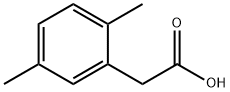
In a 250 mL dry four-necked flask, the system was evacuated and purged with nitrogen three times. Then, under nitrogen protection, 60 mL of anhydrous tetrahydrofuran, 3.46 g of magnesium shavings (molecular weight 24.3, 142.27 mmol, 1.1 eq), and a small grain of iodine (15 mg) were added sequentially. The temperature was raised to 60 °C, and approximately one-tenth of a tetrahydrofuran solution of 2,5-dimethylbenzyl chloride was slowly added dropwise [20 g of 2,5-dimethylbenzyl chloride (molecular weight 154.64, 129.33 mmol, 1 eq) dissolved in 30 mL of tetrahydrofuran]. No significant temperature rise was observed. The mixture was stirred at this temperature for about 20 minutes, at which point a significant temperature rise was observed, reaching reflux. Simultaneously, the yellow color in the solution faded, turning grayish-white. The remaining tetrahydrofuran solution of 2,5-dimethylbenzyl chloride was slowly added dropwise, completing the addition over approximately 40 minutes. After the addition was complete, the mixture was kept at this temperature for 1 hour. The magnesium shavings in the reaction solution had essentially disappeared. The reaction solution temperature was lowered to 20°C, and 56.91 g of dry carbon dioxide gas (molecular weight 44, 1.29 mol, 10 eq) was slowly introduced. After the introduction was complete, the mixture was stirred at approximately 20°C for 1 hour. The reaction was quenched by adding 50 mL of saturated ammonium chloride solution. Tetrahydrofuran was removed by vacuum distillation, and the aqueous phase was extracted three times with 40 mL of dichloromethane. The dichloromethane phases were combined, and the dichloromethane was evaporated to dryness under negative pressure to obtain 19.7 g (molecular weight 164.2, theoretical yield 21.24 g) of a white solid with a purity of 99.3%, namely 2,5-dimethylphenylacetic acid, with a yield of 92.10%.
(1H-NMR (CDCl3) δ: 2.28 (s, 3H), 2.31 (s, 3H), 3.63 (s, 2H), 7.01 (m, 2H), 7.08 (d, 1H)).