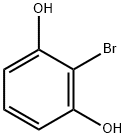
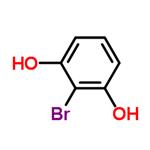
2-Bromoresorcinol is a key intermediate in the treatment of hepatitis C, specifically clopipvir hydrochloride, a pan-genotypic NS5A replication complex inhibitor that can be used in combination with sofosbuvir for the treatment of chronic hepatitis C in adults. Therefore, the development of 2-bromocatechol has a promising market prospect.
To 500 ml four-necked bottle successively added 170 g of toluene and 9.4 g of tert-butylamine, cooled down to -30 , 10.4 g of bromine slowly added dropwise, drop after drop, and then cooled down to -60 , dropwise addition of dichloromethane solution of catechol, drop after a natural warming to room temperature reaction for 24 hours, the sample is sent to the control of the HPLC; the end of the reaction, saturated sodium bisulfite quenched, dilute hydrochloric acid to adjust the pH = 1, toluene Toluene extraction, spinning to remove toluene; crude product and then distillation under reduced pressure to obtain the compound 2-bromocatechol. Yield 74-80%, HPLC 98%. This method is simple, safe and reliable, with high yield, suitable for industrialized production and the synthesis of 3-bromocatechol, which is a pharmaceutical intermediate with large socio-economic and environmental benefits.
Properties and Applications
The cyclocondensation of 2-bromoresorcinol with some aldehydes proceeds in acetonitrile-CF3SO3H to give cyclic tetramers with high stereoselectivity. 2-bromoresorcinol, C6H5BrO2, are essentially planar and possess normal geometrical parameters. The crystal packing is influenced by O-H...O and O-H...O/Br hydrogen bonds and pi-pi stacking interactions, resulting in a distinctive high-symmetry structure containing R(4)(4)(8) rings and helical C(2) chains[1-2].
[1] Peter Kirsop, William T A Harrison, John M D Storey. “1-Bromo-2,6-dihydroxybenzene containing R(4)(4)(8) rings and C(2) helices.” Acta crystallographica. Section C, Crystal structure communications 60 Pt 5 (2004): o353-5.
[2] Osamu Morikawa. “Trifluoromethanesulfonic acid-catalyzed synthesis of resorcinarenes: Cyclocondensation of 2-bromoresorcinol with aldehydes.” Synthesis-Stuttgart 40 1 (2002): 761–765.