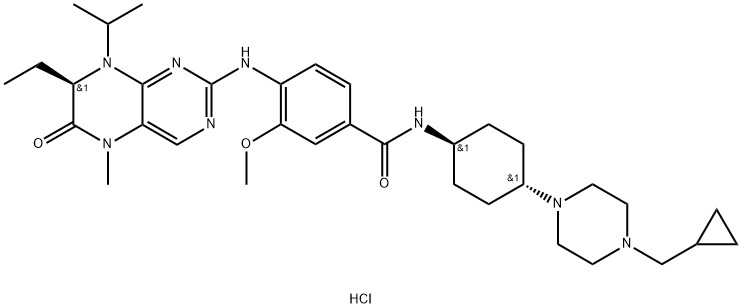
Volasertib trihydrochloride (BI 6727 trihydrochloride; A total weekly dose of 50 mg/kg; Oral; once a week, twice a week, or daily; for 40 days) shows comparable efficacy in human colon carcinoma xenograft models[1].
Volasertib trihydrochloride (15, 20, or 25 mg/kg/day; i.v.; 2 consecutive days per week; for 40 days) leads to significant tumor growth delay and even tumor regression in human colon carcinoma xenograft models [1].
Volasertib trihydrochloride (70 mg/kg given once weekly or 10 mg/kg daily; oral) significantly delays tumor growth in a non-small cell lung carcinoma xenograft model derived from NCI-H460 cells[1].
Volasertib (a single dose of 40 mg/kg; iv) causes a significant (13-fold) increase in mitotic cells in HCT 116 tumor-bearing nude mice[1].
Volasertib has high volume of distribution and a long terminal half-life in mice (Vss=7.6 L/kg, t1/2=46 h) and rats (Vss=22 L/kg, t1/2=54 h)[1].
| Animal Model: | Female BomTac:NMRI-Foxn1nu mice (Taconic) were grafted s.c. with HCT 116 human colon carcinoma cells (ATCC CCL-247)[1] |
| Dosage: | A total weekly dose of 50 mg/kg |
| Administration: | Oral; once a week, twice a week, or daily; for 40 days |
| Result: | Showed comparable efficacy and were well tolerated.
|
| Animal Model: | Female BomTac:NMRI-Foxn1nu mice and male Wistar rats of the strain Crl:WI[1] |
| Dosage: | 35 mg/kg (mice) or 10 mg/kg (rat) (Pharmacokinetic Analysis) |
| Administration: | IV 5-minute infusion; a single dose 5-minute infusion |
| Result: | Had high volume of distribution and a long terminal half-life in mice (Vss=7.6 L/kg, t1/2=46 h) and rats (Vss=22 L/kg, t1/2=54 h).
|