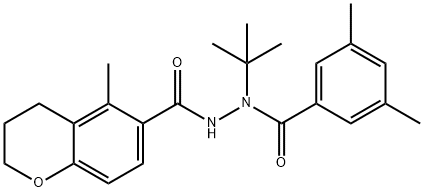
Chromafenozide is an insecticide used to control a range of pests on fruit and other crops. It has a very low aqueous solubility and is volatile. It is persistent in soil systems and may also be persistent in aquatic systems under certain conditions. It has a low mammalian toxicity and no significant health effects have been identified. It is moderately toxic to aquatic life but has a low toxicity to honeybees and earthworms.
Pure product is white crystal, melting point 186.4℃, vapor pressure 4×10⁻⁹Pa (25℃), solubility in water is 1.12mg/L (20℃).
Chromafenozide is a diacylhydrazine based lepidopteran insect control agent. Chromafenozide is a non-steroidal ecdysteroid agonist. Chromafenozide functions as a insect growth regulator that disrupts hormonal regulation of insect''s molting process causing its death.
ChEBI: Chromafenozide is a bisacylhydrazine insecticide. It is functionally related to a benzohydrazide.
The commercial production of chromafenozide follows a concise two-step hydrazide coupling process. First, 5-methyl-4-chromanecarboxylic acid is converted to its acid chloride using thionyl chloride in toluene. This acid chloride is then reacted with tert-butylhydrazine hydrochloride in dichloromethane with triethylamine forming the hydrazide linkage; the mixture is washed with water, concentrated, and recrystallised from isopropanol to yield technical-grade chromafenozide.
Ingestion, forces an incomplete and lethal moult. Ecdysone receptor agonist. A moulting hormone agonist.
Chromafenozide (0.39-39.4 ng/larva; topical application; 7 days) shows high toxicity against Spodoptera exigua and Spodoptera littoralis[2].