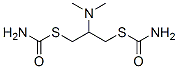
Cartap can be used to control a variety of pests and nematodes, including those in the orders Lepidoptera, Coleoptera, Hemiptera, and Diptera, while having little impact on predatory mites.
Cartap is a largely obsolete insecticide. It is highly soluble in water, has a low volatility and tends not to persist in soil systems. There are data gaps regarding its human health effects but is known to be moderately toxic. There are also data gaps regarding its ecotoxicity but is highly toxic to aquatic vertebrates and moderately toxic to fish.
Cartap, commonly formulated as cartap hydrochloride, is produced through a multi-step chemical synthesis involving amination and thiocarbamate formation. The process begins with the reaction of propylene chloride with dimethylamine and an alkali solution at low temperatures, followed by heating to around 45 DegC to complete the amination step. This yields an intermediate compound that is further reacted to cartap hydrochloride.
Phytotoxic. Nicotinic acetylcholine receptor (nAChR) channel blocker.