Purification intermediate in refining nickel; catalyst in the petroleum, plastic, and rubber industries
Nickel carbonyl is a clear colourless to yellow volatile liquid, is flammable, and burns with
a yellow flame. It is denser than water and insoluble in water but soluble in alcohol, benzene,
chloroform, acetone, ethanol, carbon tetrachloride, and nitric acid. The vapours are
heavier than air. In industries, nickel carbonyl is used in nickel coat steel and other metals
and to make very pure nickel. Nickel carbonyl gets peroxidised by air as a solid deposit
and decomposes to ignite.
Nickel carbonyl is a colorless, highly volatile,
flammable liquid with a musty odor. The Odor Threshold
is 1.3 ppm. It decomposes above room temperature producing
carbon monoxide and finely divided nickel.
colourless liquid with a musty odour
Colorless volatile liquid; diamagnetic; flammable; burns with a bright luminous flame; density 1.319 g/mL; freezes at -25°C; boils at 43°C; vapor pressure 320.6 torr at 20°C; vapor density 5.89 (air=1); critical temperature about 200°C; critical pressure 30 atm; practically insoluble in water, 180 mg/L at 10°C; miscible with most organic solvents including ethanol, acetone, and benzene; soluble in nitric acid and aqua regia.
Nickel tetracarbonyl was prepared first in 1888 by Mond and Langer by passing carbon monoxide over finely divided nickel. It is the most important zero valent compound of nickel and is used industrially to make high-purity nickel powder and pellets and to produce nickel coatings on steel.
Nickel carbonyl is used in nickel vapoplating processes in
the metallurgical and electronics industry, and in the catalytic
methyl- and ethylacrylate monomer synthesis. For many
years it had been used to produce pure nickel by the
Mond process, which has been considered to be outdated
since around 1970.
Nickel tetracarbonyl is used in the manufactureof nickel powder and nickel-coatedmetals, and as a catalyst in carboxylation,coupling, and cyclization reactions. It canform from the contact of carbon monoxidewith nickel.
In organic synthesis; production of high-purity nickel powder and continuous nickel coatings on steel and other metals.
Nickel tetracarbonyl is made by passing carbon monoxide over finely divided nickel at 50 to 100°C. (The finely divided nickel is obtained from reduction of nickel oxide by hydrogen below 400°C.) Ni + 4CO → Ni(CO)4
In several commercial processes the reaction is carried out at a temperature of 200°C under 400 atm carbon monoxide pressure for obtaining high yield of nickel tetracarbonyl and also to prevent thermal dissociation.
Nickel tetracarbonyl may be prepared in the laboratory by the Hieber process, a disproportion reaction of several nickel compounds of organic thio acids, such as nickel(II) phenyldithiocarbamate, (C6H5—NH—C(=S)—S)2Ni, with carbon monoxide under controlled conditions. In such disproportionation reactions, the divalent nickel ion converts to a tetravalent nickel complex (Hieber. H. 1952. Z.anorg.Chem., 269, pp. 28). The overall reaction is: 2NiII + 4CO → NiIV(complex) + Nio(CO)4.
Nickel carbonyl is produced in a reaction of carbon monoxide
and nickel metal. It may also be formed as a by-product in
the industrial processes using nickel catalysts, such as coal
gasification, crude oil refining, and hydrogenation reactions
(293). Conditions for its formation occur in those
processes where carbon monoxide is in contact with an
active form of nickel under conditions of elevated pressure
at 50–150°C.
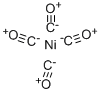
A zero-valent compound. The four carbonyl groups
form a tetrahedral arrangement and are linked covalently to the metal through the carbons
nickel carbonyl: A colourlessvolatile liquid, Ni(CO)4; m.p.-25°C;b.p. 43°C. It is formed by direct combinationof nickel metal with carbonmonoxide at 50–60°C. The reaction isreversed at higher temperatures, andthe reactions are the basis of theMond process for purifying nickel.The nickel in the compound has anoxidation state of zero, and the compoundis a typical example of a complexwith pi-bonding ligands, inwhich filled d-orbitals on the nickeloverlap with empty p-orbitals on thecarbon.
A clear colorless to yellow liquid. Boiling point 43°C. Flash point below 0°F. Very toxic by ingestion and inhalation. Carcinogenic. Denser than water and insoluble in water. Vapors heavier than air. Used to nickel coat steel and other metals and to make very pure nickel.
Highly flammable over a wide range of vapor-air concentrations. Is peroxidized by air to give a solid deposit that tends to decompose and ignite. Insoluble in water.
NICKEL CARBONYL is easily oxidized. Presents a very serious fire hazard if exposed to heat, flame, sparks, oxidizing agents. Explodes when heated to about 60°C. Reacts explosively with bromine (liquid), oxygen in the presence of mercury, or hydrocarbons (butane) mixed with oxygen. Undergoes violent reactions with air, oxygen, dinitrogen tetraoxide. Caused an explosion when added to an n-butane-oxygen at 20-40°C [J. Am. Chem. Soc. 70:2055-6. 1948]. Reacts with tetrachloropropadiene to form an extremely explosive dinickel chloride dimer. Emits highly toxic fumes of carbon monoxide when heated to decomposition or in contact with mineral acids or acid fumes [Bretherick, 5th ed., 1995, p. 1734]. Vapor explodes in air or oxygen at 20°C and a partial pressure of 15 mm.
Flammable, dangerous fire risk, explodes
at 60C (140F). A lung irritant and confirmed carcinogen.
Probable oral lethal dose for a human is between 50 and 500 mg/kg, between one teaspoon and one ounce per 150 lb. person. NICKEL CARBONYL has also been estimated to be lethal in man at atmospheric exposures of 30 ppm for 20 minutes. Autopsies show congestion, collapse, and tissue destruction, as well as hemorrhage in the brain. Dermatitis, recurrent asthmatic attacks, and increased number of white blood cells (eosinophils) in respiratory tract are acute health hazards. NICKEL CARBONYL is poisonous. It can be fatal if inhaled, swallowed, or absorbed through skin. Vapors may cause irritation, congestion, and edema of lungs.
Nickel tetracarbonyl is an extremely toxicsubstance by all routes of exposure exhibitingboth immediate and delayed effects. Thedelayed effects may manifest in a few hoursto days after exposure. Exposure to its vaporscan cause dizziness, giddiness, headache,weakness, and increased body temperature.Vapors are irritating to eyes, nose, andthroat. Prolonged exposure or inhalation ofits vapors at a further increased level ofconcentration may produce rapid breathing,followed by congestion of the lungs. Therespiration will initially be rapid with nonproductivecough, progressing to pain andtightness in the chest (U.S. EPA 1995). Highexposure can cause convulsion, hemorrhage,and death. Other symptoms from inhalationof vapors or ingestion of the liquid includehallucinations, delirium, nausea, vomiting,diarrhea, and liver and brain injury.
In humans, a 30-minute exposure to a 30-ppm concentration in air could be fatal. Afew whiffs of the vapors of the liquid cancause death. One minute exposure to 3000ppm of its vapor can cause death in humansfrom respiratory failure and acute pulmonaryedema. Similarly, swallowing 5–10 mL ofthe liquid can be fatal.
Nickel tetracarbonyl can be absorbedthrough the skin. While the skin contact witha dilute solution can cause dermatitis anditching, that from a concentrated solution orthe pure liquid can produce a burn. Absorptionof the liquid through the skin may resultin death. The subcutaneous and intravenousLD50 values in rats are 60–70 mg/kg.
LC50 (mouse): 0.067 mg/L/30 min (RTECS2004)
Evidence of carcinogenicity observed inexperimental animals dosed with nickel tetracarbonyl is limited. It caused tumors inthe lungs and liver. The compound is alsoteratogenic, causing birth defects.
The acute toxicity of nickel carbonyl by inhalation is high. Acute toxic effects occur
in two stages, immediate and delayed. Headache, dizziness, shortness of breath,
vomiting, and nausea are the initial symptoms of overexposure; the delayed effects
(10 to 36 h) consist of chest pain, coughing, shortness of breath, bluish discoloration
of the skin, and in severe cases, delirium, convulsions, and death. Recovery is
protracted and characterized by fatigue on slight exertion. Nickel carbonyl is not
regarded as having adequate warning properties.
Repeated or prolonged exposure to nickel carbonyl has been associated with an
increased incidence of cancer of the lungs and sinuses. Nickel carbonyl is listed by
IARC in Group 2B ("possible human carcinogen"), is listed by NTP as "reasonably
anticipated to be a carcinogen," and is classified as a "select carcinogen'' under the
criteria of the OSHA Laboratory Standard.
Nickel carbonyl is a highly flammable liquid (NFPA rating = 3) that may ignite
spontaneously and explodes when heated above 60℃. Its lower flammable limit in
air is 2% by volume; the upper limit has not been reported. Carbon dioxide, water, or
dry chemical extinguishers should be used for nickel carbonyl fires.
Vapor forms explosive mixtures with air. Vapor is heavier than air and may travel a considerable distance to source of ignition and flash back. Liquid may explode when heated under confinement. Vapor explosion and poison hazard indoors, outdoors, or in sewers. Runoff to sewer may create fire and explosion. May explode at 68F in presence of air or oxygen. Avoid contact with heat, acid or acid fumes as these cause the emission of highly toxic fumes. Avoid contact with air, ignition sources and vapors entering a confined space.
Flammability and Explosibility
Nickel carbonyl is a highly flammable liquid (NFPA rating = 3) that may ignite
spontaneously and explodes when heated above 60 °C. Its lower flammable limit in
air is 2% by volume; the upper limit has not been reported. Carbon dioxide, water, or
dry chemical extinguishers should be used for nickel carbonyl fires.
ConfEmed carcinogen
with experimental carcinogenic,
tumorigenic, and teratogenic data. A human
poison by inhalation. Poison experimentally
by inhalation, intravenous, subcutaneous,
and intraperitoneal routes. An experimental
teratogen. Other experimental reproductive
effects. Human systemic effects by
inhalation: somnolence, fever, and other
pulmonary changes. Vapors may cause
coughing, dyspnea (difficult breathing),
irritation, congestion and edema of the
lungs, tachycardia (rapid pulse), cyanosis,
headache, dizziness, and weakness. Toxicity
by inhalation is believed to be caused by
both the nickel and carbon monoxide
liberated in the lungs. Chronic exposure may
cause cancer of lungs, nasal sinuses.
Sensitization dermatitis is fairly common.
Probably the most hazardous compound of
nickel in the workplace. A common air
contaminant. It is lipid soluble and can cross
biological membranes (e.g., lung alveolus,
blood-brain barrier, placental barrier).
A very dangerous fire hazard when
exposed to heat, flame, or oxidizers.
Moderate explosion hazard when exposed
to heat or flame. Explodes when heated to
about 60°. Explosive reaction with liquid
bromine, mercury + oxygen, oxygen +
butane. Violent reaction with dinitrogen
tetraoxide, air, oxygen. Reacts with
tetrachloropropadtene to form the extremely
sensitive explosive dicarbonyl
trichloropropenyl dinickel chloride dimer.
Can react with oxidzing materials. To fight
fire, use water, foam, CO2, dry chemical.
When heated to decomposition or on
contact with acid or acid fumes, it emits
highly toxic fumes of carbon monoxide. See
also NICKEL COMPOUNDS and
CARBONYLS.
Nickel carbonyl is used as an intermediate
product in the refining of nickel. The primary use for
nickel carbonyl is in the production of nickel by the Mond
process. Impure nickel powder is reacted with carbon monoxide
to form gaseous nickel carbonyl which is then treated
to deposit high purity metallic nickel and release carbon
monoxide. Other uses include gas plating; the production
of nickel products; in chemical synthesis as a catalyst, particularly
for oxo reactions (addition reaction of hydrogen
and carbon monoxide with unsaturated hydrocarbons to
form oxygen-function compounds); e.g., synthesis of
acrylic esters; and as a reactant.
Work with nickel
carbonyl should be conducted in a fume hood to prevent exposure by inhalation and
splash goggles and impermeable gloves should be worn at all times to prevent eye
and skin contact. Nickel carbonyl should only be used in areas free of ignition
sources. Containers of nickel carbonyl should be stored in secondary containers in
the dark in areas separate from oxidizers.
UN1259 Nickel carbonyl, Hazard Class: 6.1;
Labels: 6.1-Poisonous materials, 3-Flammable liquid,
Inhalation Hazard Zone A. A United States DOT Severe
Marine Pollutant.
May spontaneously ignite on contact
with air. In the presence of air, oxidizes and forms a
deposit which becomes peroxidized; this tends to decompose
and ignite. May explode when heated above 60 C.
Decomposes on contact with acids producing carbon monoxide.
Violent reaction with oxidizers; may cause fire and
explosions. Vapor may promote the ignition of mixtures of
combustible vapors (such as gasoline) and air. Attacks
some plastics, rubber and coatings. Store under inert gas
blanket.
Incineration in admixture
with a flammable solvent. Also, nickel carbonyl used in
metallizing operations may be recovered and recycled.
Consult with environmental regulatory agencies for guidance
on acceptable disposal practices. Generators of waste
containing this contaminant (≥100 kg/mo) must conform
with EPA regulations governing storage, transportation,
treatment, and waste disposal.