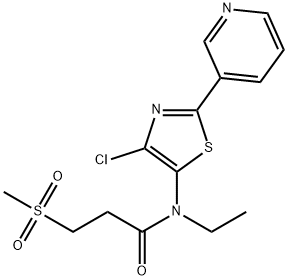
Tiapyrachlor is commercially produced by synthesising the active ingredient N-[4-chloro-2-(3-pyridinyl)-5-thiazolyl]-N-ethyl-3-(methylsulfonyl)propenamide through multi-step organic reactions, typically starting from thiazole and pyridine intermediates. The process includes chlorination, sulfonylation, and amidation steps to achieve the final crystalline form, which is then formulated into pesticidal compositions.
Unclear but thought to interfer with an insect's nervous system, specifically its neurotransmission, interacting with the chordotonal TRPV channels