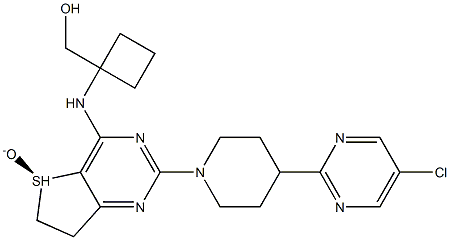
Nerandomilast (Example 2) (0, 0.3, 1.0 and 3.0 mg/kg; p.o.; single dose) weakens intestinal transport in rats at 1.0 mg/kg without significantly affecting body weight[1].
Nerandomilast prevents inflammation in rat lung tissue with an ED50 value of 0.1 mg/kg[1].
Nerandomilast (0.01, 0.1 and 1.0 mg/kg; p.o.; single dose) reduces the Lipopolysaccharides (HY-D1056) induced TNF-α release with dose-dependent manner in mice plasma[2].
Nerandomilast (0.1, 0.3 and 1.0 mg/kg; p.o.; single dose) inhibits lipopolysaccharides induced neutrophil entry into bronchoalveolar lavage fluid of male Suncus Murinus and Wistar rats[2].
Nerandomilast (2.5 mg/kg and 12.5 mg/kg; p.o.; twice daily for 6 days) effectively improves the damage of Bleomycin (HY-108345) to mice[2].
| Animal Model: | Rats[1]. |
| Dosage: | 0, 0.3, 1.0 and 3.0 mg/kg. |
| Administration: | Oral gavage; single dose. |
| Result: | Had minimal toxic and side effects on the intestines and stomach of rats, demonstrating biosafety. |
| Animal Model: | Male Suncus Murinus and Wistar rats; mice[2]. |
| Dosage: | 0.01, 0.1, 0.3, 1.0, 2.5 or 12.5 mg/kg. |
| Administration: | Oral gavage; single dose or twice daily for 6 days. |
| Result: | Effectively improved inflammation in lung tissue and reduced the pro-inflammatory factor TNF-α release. |