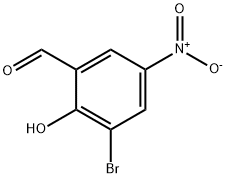
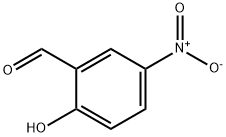
General procedure for the synthesis of 3-bromo-2-hydroxy-5-nitrobenzaldehyde from 5-nitrosalicylaldehyde: 2-hydroxy-5-nitrobenzaldehyde (2.0 g, 12 mmol) and dichloromethane (30 mL) were added to a 100 mL two-necked flask, followed by the addition of bromine (2.24 g, 14 mmol) dropwise. The reaction mixture was stirred at room temperature for 1 hour. Upon completion of the reaction, the reaction was quenched with saturated aqueous sodium thiosulfate (100 mL) and the mixture was transferred to a separatory funnel for layering. The aqueous phase was extracted with ethyl acetate (100 mL × 2). The organic phases were combined, washed with saturated brine (80 mL × 2), dried over anhydrous sodium sulfate, filtered and concentrated under reduced pressure. The residue was purified by silica gel column chromatography (eluent: ethyl acetate/petroleum ether, v/v = 1/20) to afford 3-bromo-2-hydroxy-5-nitrobenzaldehyde as a yellow solid (2.89 g, 98% yield). Mass spectrum (ES-API, cation mode) m/z: 246.9 [M + 2]+.
[1] Organic Letters, 2011, vol. 13, # 1, p. 26 - 29
[2] Tetrahedron Letters, 2005, vol. 46, # 51, p. 8959 - 8963
[3] Patent: WO2017/36404, 2017, A1. Location in patent: Page/Page column 115
[4] Journal of Organic Chemistry, 2007, vol. 72, # 15, p. 5867 - 5869
[5] Patent: CN108623615, 2018, A. Location in patent: Paragraph 0332; 0547; 0548; 0549