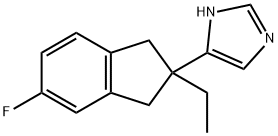
Fipamezole (MPV 1730; JP-1730) is a potent and orally active α2-adrenergic receptor antagonist with Ki values of 9.2 nM, 17 nM, and 55 nM for human α2A, α2B, and α2C, receptors, respectively. Fipamezole is an anti-dyskinetic agent, and can be used for the study of Parkinson's disease[1].
in vivo
In the MPTP-lesioned marmoset, Fipamezole (1-10 mg/kg; po; once) significantly reduces L-dopa-induced dyskinesia without compromising the anti-parkinsonian action of L-DOPA (HY-N0304)[1].
Animal Model:
Adult common marmosets (Callithrix jacchus, 300-345 g) injected with MPTP hydrochloride (2 mg/kg) and L-DOPA (8 mg/kg)[1]
Dosage:
1 mg/kg, 3 mg/kg, 10 mg/kg
Administration:
po; once
Result:
Significantly reduced L-DOPA-induced dyskinesia.
IC 50
human α2A-adrenoceptor: 9.2 nM (Ki); human α2B-adrenoceptor: 17 nM (Ki); human α2C-adrenoceptor: 55 nM (Ki)
References
[1] Juha-Matti Savola, et al. Fipamezole (JP-1730) is a potent alpha2 adrenergic receptor antagonist that reduces levodopa-induced dyskinesia in the MPTP-lesioned primate model of Parkinson's disease. Mov Disord. 2003 Aug;18(8):872-83. DOI:10.1002/mds.10464