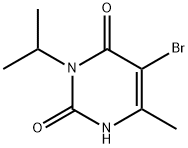
A detailed manufacturing route for isocil is not available in open literature but its structure and chemical class make its industrial production reasonably inferable from standard uracil herbicide synthesis. Isocil is a brominated, alkyl substituted uracil, so commercial manufacture would begin with construction of the 6 methyluracil core, typically via condensation of a beta ketoester with urea under acidic or thermal conditions to form the pyrimidinedione ring. The isopropyl substituent at the 3 position would then be introduced through controlled alkylation of the uracil nitrogen using an isopropyl halide or sulphate ester. Finally, selective bromination at the 5 position, using a brominating agent such as bromine or N bromosuccinimide under conditions that preserve the sensitive heterocycle, yields the final herbicide, which is then purified and formulated.