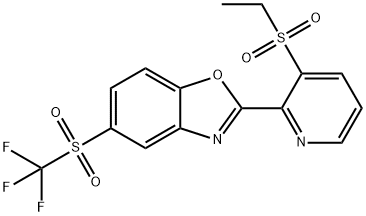
Oxazosulfyl is produced through an industrial route that assembles its oxadiazolone core and heavily substituted aryl-sulfonyl side chain using a modular strategy designed to control sulphur-based impurities and halogenated by-products. Commercial syntheses typically begin with construction of the 1,3,4-oxadiazol-2-one ring from an appropriate hydrazide or acylhydrazine precursor, followed by cyclisation under dehydrating conditions to establish the heterocycle. In parallel, the fluorinated aryl-sulfonyl fragment is prepared through controlled halogenation and sulfonylation steps, then converted into a reactive sulfonyl chloride or equivalent. The key assembly stage is the coupling of this activated sulfonyl intermediate with the oxadiazolone nucleus under anhydrous, base-mediated conditions that suppress over-sulfonylation and decomposition of the heterocycle.