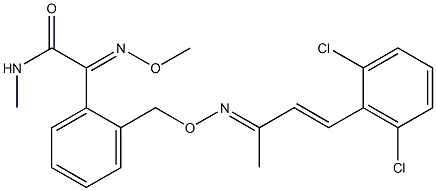
Fenaminstrobin is used as a fungicide and pesticide.
Fenaminstrobin is produced commercially through a strobilurin-type synthetic route that constructs its methoxyiminoacetamide backbone and couples it with a dichlorophenyl-substituted butenylidene fragment. The process begins with preparation of the methoxyiminoacetic acid derivative, which is then condensed with methylamine to form the amide core. In parallel, a 2,6-dichlorophenyl butenylidene intermediate is synthesised via controlled halogenation and olefination steps. These fragments are joined through an oxy-methyl linkage to yield the characteristic strobilurin structure. Industrial production requires strict control of stereochemistry to ensure the biologically active (E,E)-configuration, followed by purification through recrystallization or chromatography to achieve technical-grade material.
ChEBI: Fenaminstrobin is a monocarboxylic acid amide obtained by formal condensation of the carboxy group of (2E)-{2-[({(E)-[(3E)-4-(2,6-dichlorophenyl)but-3-en-2-ylidene]amino}oxy)methyl]phenyl}(methoxyimino)acetic acid with the amino group of methylamine. A broad-spectrum fungicide. It has a role as a mitochondrial cytochrome-bc1 complex inhibitor and an antifungal agrochemical. It is an oxime O-ether, a monocarboxylic acid amide, an olefinic compound, a dichlorobenzene, an amide fungicide and a methoxyiminoacetamide strobilurin antifungal agent.
Broad-spectrum. Respiration inhibitor- Quinone Outside Inhibitor (QoI).