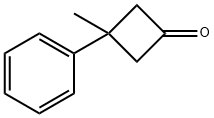
The synthesis of 3-methyl-3-phenylcyclobutanone typically involves constructing a four-membered ring via [2+2] cycloaddition or ring-closing reactions, followed by the introduction of methyl and phenyl substituents. A common strategy is to cyclize precursors such as γ-keto acids or their derivatives; for example, cyclizing (+)-3-methyl-3-phenyladipic acid to form a cyclobutanone ring. Another approach is to first enantioselectively deprotonate the simpler 3-phenylcyclobutanone, followed by methylation of the resulting chiral enol; this method is often used to obtain the enantiomeric pure form of the compound.