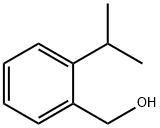
(2-Isopropylphenyl)methanol is used as an intermediate in organic synthesis for the synthesis of more complex organic compounds, such as drugs, pesticides, or dyes.
(2-Isopropylphenyl)methanol is usually a colorless to slightly yellow liquid, and its structure consists of a benzene ring forming the main body, with an isopropyl group and a methanol group attached to position 2 of the benzene ring. Alcohol hydroxyl groups can undergo many reactions, such as esterification, oxidation, substitution, and so on.
To a solution of 2-ethylbenzaldehyde (200 mg, 1.49 mmol) in ethanol (4.0 mL) cooled to 0C was added sodium borohydride (11.27 mg, 0.30 mmol). The mixture was stirred at 0C for 1 hour, then allowed to reach 25C and stirred for 1 hour. Thereafter, NH4Cl was added, the solvent was evaporated and the residue was extracted with ethyl acetate (3 x 5 mL). The combined organic phases were dried with anhydrous Na2SO4, filtered and concentrated. The resulting residue was purified by rapid chromatography on silica gel (1:50 methanol/dichloromethane) to give (2-isopropylphenyl)methanol as a colorless oil (74% yield).