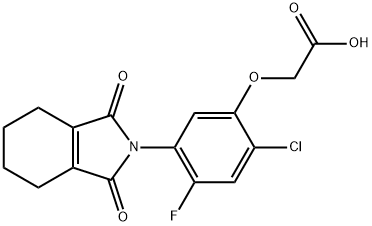
Flumiclorac is normally used as the pentyl variant. It is a herbicide for problematic broadleaved weeds. It has a low aqueous solubility, is volatile and, based on its chemical properties, whilst it is mobile it is not expected to leach to groundwater. It tends not to be persistent in soil and aquatic systems degrading by both hydrolysis and photolysis. It has a low mammalian toxicity and is a recognised irritant. It is moderately toxic to fish and aquatic invertebrates, and relatively non-toxic to honeybees.
Flumiclorac is produced using the same broad industrial logic that underpins many nitrodiphenyl ether herbicides: assemble the substituted diphenyl-ether backbone first, then introduce the activated side chain that gives the molecule its herbicidal behaviour. Manufacturers begin with two appropriately substituted chlorinated phenols and link them through a controlled nucleophilic aromatic substitution to form the diphenyl-ether core while suppressing the by products typical of this chemistry. Once the backbone is in hand, the nitro group and other electron-withdrawing substituents are introduced under conditions that avoid over-nitration or ring degradation. The final step installs the chloroacetyl-type side chain through a selective acylation that preserves the sensitive nitro-substituted aromatic system.
Fast contact action, absorbed by foliage. Cell membrane disruption - enzyme protoporphyrinogen oxidase inhibitor.