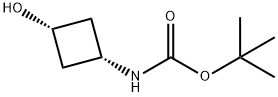
Amino alcohols, with their skeletal structure, are widely found in natural products and bioactive molecules. These compounds serve as effective intermediates in pharmaceutical chemistry, providing a wealth of research material for drug development. Furthermore, the two heteroatoms (N, O) of amino alcohols offer high flexibility, allowing one or both heteroatoms to bond with Lewis acids, transition metals, or achiral substrates. This makes them widely applicable in asymmetric synthesis, such as asymmetric reduction and addition of carbonyl groups, asymmetric Diels-Alder cycloaddition reactions, asymmetric 1,2-dipolar cycloaddition reactions, and Heck reactions.