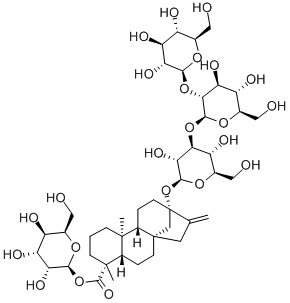
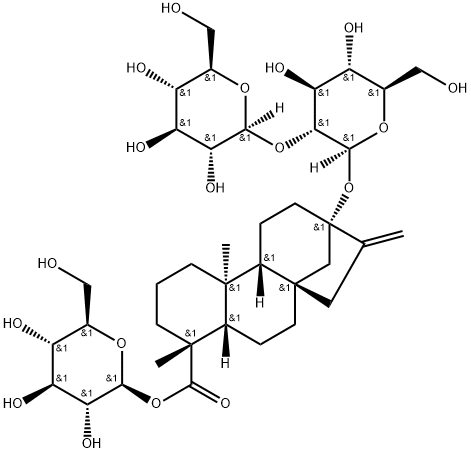
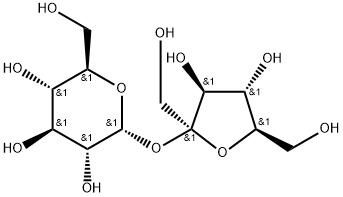
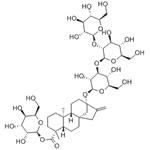
A new structure based on (2S,3R,4S,5S,6R)-3,4,5-trihydroxy-6-(hydroxymethyl)tetrahydro-2H-pyran-2-yl((4R,4aS,6aR,9S,11aR,11bS)-9-(((2S,3R,4S,5S,6R)-4,5-dihydroxy-6-(hydroxymethyl)-3-(((2S,3R,4S,5S,6R )-3,4,5-trihydroxy-6-(hydroxymethyl)tetrahydro-2H-pyran-2-yl)oxy)tetrahydro-2H-pyran-2-yl)oxy-4,11b-dimethyl-8-methylenetetradecahydro-6a,9-methylcyclohepta[a]naphthalene-4-carboxylic acid ester and sucrose were used as raw materials, and the general procedure for the synthesis of rebaudioside A was as follows: firstly, the expression in E. coli of pEUGT- SUS vector in E. coli, followed by collecting the cells and washing them twice with potassium phosphate buffer (100 mM, pH 7.2). Next, the cells were broken by sonication in an ice-water bath and centrifuged at 4°C to remove cellular debris to obtain a lysate supernatant containing soluble proteins. This supernatant is the crude extract. The total protein concentration of the crude extract was determined by the Bradford method using bovine serum albumin (BSA) as a standard. Finally, rebaudioside A was synthesized by reacting the substrate acaricide with an equal volume of the crude extract in potassium phosphate buffer (100 mM, pH 7.2) containing different concentrations of UDP-glucose or UDP, sucrose, and 3 mM MgCl2 at 30 °C.