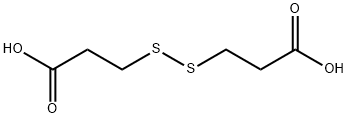
Sodium hydride (1.20 g, 28.5 mmol, 57% dispersed in oil) was washed with pentane (3 × 10 ml) to remove it from the oil and suspended in 25 ml of DMF. A small amount of thiol (25 mmol) was added under a nitrogen atmosphere, and the mixture was stirred at 20°C for 15 minutes. At room temperature, a pre-weighed rubber bulb was filled with CF3I (6.5–7.0 g, 33–35 mmol, 1.3–1.4 equivalents) and fixed to the neck of the burnt vessel. The mixture immediately turned yellow and was stirred overnight at room temperature. At the end of stirring, a white precipitate formed. The slurry was poured into 200 ml of water, and the mixture was set for distillation. The product was separated by steam distillation, the organic layer was separated from the aqueous phase, the aqueous phase was extracted with diethyl ether (2 × 15 ml), the homogeneous organic phase was washed with water (3 × 10 ml), and dried over brine (10 ml) (Na2SO4). After filtration, the ether was evaporated under reduced pressure (~16 mmHg) to obtain the pure product 3,3'-Dithiodipropionic acid.
3,3′-Dithiodipropionic acid was used as capping agent for introducing charge on gold nanoparticles surfaces.
3,3′-Dithiodipropionic acid forms monolayers on a polycrystalline gold electrode through a self-assembly procedure to form gold 3,3′-dithiodipropionic acid self-assembled monolayer modified electrode. It is the precursor substrate in the synthesis of 3-mercaptopropionic acid-containing polythioesters. It is added as primary carbon supplement in the culture medium of novel betaproteobacterium, strain DPN7.
Besides 3MP, also the organic sulfur compounds (OSCs) 3,3'-thiodipropionic acid (TDP) and 3,3'-dithiodipropionic acid (DTDP) are established precursor substrates for poly(3HB-co-3MP) biosynthesis in R. eutropha H16. Both precursors offer advantages in comparison to 3MP. While higher concentrations of 3MP seriously impair growth of R. eutropha H16, TDP and DTDP are nontoxic OSCs[1-2].
[1] Christina Doberstein . “Polythioester synthesis in Ralstonia eutropha H16: Novel insights into 3,3′-thiodipropionic acid and 3,3′-dithiodipropionic acid catabolism.” Journal of biotechnology 184 (2014): Pages 187-198.
[2] Jan Hendrik Wübbeler. “Dihydrolipoamide dehydrogenases of Advenella mimigardefordensis and Ralstonia eutropha catalyze cleavage of 3,3’-dithiodipropionic acid into 3-mercaptopropionic acid.” ACS Applied Electronic Materials (2010): 7023–8.