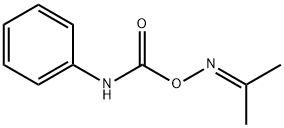
Proximpham was produced through a sequence typical of this class: formation of a substituted phenyl isocyanate or carbamoyl chloride intermediate, followed by controlled coupling with the appropriate alkyl or aryl substituted hydroxylamine derivative. Industrial routes generally relied on phosgenation or equivalent carbonyl transfer chemistry to generate the reactive carbamoyl species, with acid scavengers and inert solvents used to maintain selectivity and suppress side reactions. After condensation, the crude proximpham was purified by crystallisation or solvent washing to reach technical grade purity before being formulated into herbicidal products.