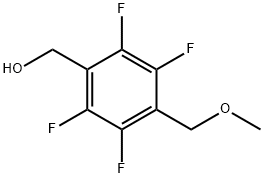
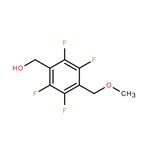
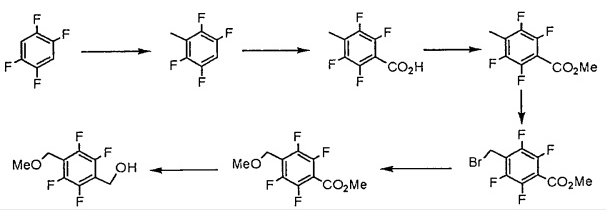
Method 1: Using 1,2,4,5-tetrafluorobenzene as a starting material, a reaction is carried out to produce 4-methoxymethyl-2,3,5,6-tetrafluorobenzyl alcohol:
Method 2: 4-methoxymethyl-2,3,5,6-tetrafluorobenzyl alcohol is produced by selective methylation of 2,3,5,6-tetrafluoro-1,4-benzenedimethanol. The specific steps are as follows:
1) 2,3,5,6-tetrafluoro-1,4-benzenedimethanol reacts with an inorganic base in water and a water-immiscible organic solvent selected from hydrocarbons and ethers,
2) Dimethyl sulfate and, optionally, a water-immiscible organic solvent are added to the reaction mixture to give the target compound, 4-methoxy-2,3,5,6-tetrafluorobenzyl alcohol. In step 2), the reaction must be carried out in water and a water-immiscible organic solvent selected from hydrocarbons and ethers. Examples of water-immiscible organic solvents include aromatic hydrocarbons such as toluene and xylene, aliphatic hydrocarbons such as hexane and heptane, and others such as tert-butyl methyl ether.