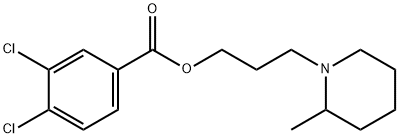
Piperalin is a component of pesticide combinations. Fungicide, used in the treatment of fungi Ustilago maydis.
ChEBI: 3-(2-methylpiperidin-1-yl)propyl 3,4-dichlorobenzoate is a member of the class of piperidines that is 2-methylpiperidine in which the hydrogen attached to the nitrogen is replaced by a 3-[(3,4-dichlorobenzoyl)oxy]propyl group. It is a member of piperidines, a tertiary amino compound, a benzoate ester and a dichlorobenzene. It is functionally related to a 3,4-dichlorobenzoic acid.
Piperalin is synthesised through a multi-step process that begins with the preparation of 2-methylpiperidine, which introduces chirality into the molecule. This intermediate is then reacted with 3-chloropropanol to form a 3-(2-methylpiperidino)propanol derivative. In the next step, this alcohol undergoes esterification with 3,4-dichlorobenzoic acid, typically using a coupling agent like dicyclohexylcarbodiimide or acid chlorides to facilitate the formation of the ester bond. The reaction is carried out under controlled conditions, often in an organic solvent such as dichloromethane or toluene, and followed by purification steps like liquid-liquid extraction and distillation to isolate the final product.
Inhibits sterol biosynthesis in membranes. Inhibits sterol biosynthesis in membranes.