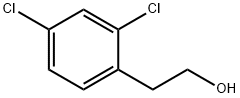
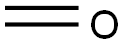
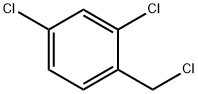
The general procedure for the synthesis of 2,4-dichlorophenethyl alcohol from formaldehyde and 2,4-dichlorobenzyl chloride is as follows: a two-necked Schlenk flask equipped with a magnetic stirring bar and a septum is heated under high vacuum with a hot air gun (ca. 400 °C) for 10 minutes. After cooling to room temperature, the flask was rinsed three times with argon. Zinc powder (654 mg, 2.0 equiv, 10.0 mmol) and THF (20 mL) were added sequentially. 1,2-Dibromoethane (5 mol%) was added and the reaction mixture was heated to boiling. After cooling to room temperature, chlorotrimethylsilane (1 mol%) was added and the mixture was again heated to boiling. After cooling to room temperature again, a solution of 2,4-dichlorobenzyl chloride (633 mg, 5.0 mmol, 1 eq.) in THF (10 mL) was added and the reaction mixture was heated at 70 °C for 2 hours and then cooled to room temperature. Paraformaldehyde (450 mg, 3.0 eq., 15.0 mmol) was slowly added at room temperature and the flask was heated again at 70 °C for 6 hours. After completion of the reaction, the solution was cooled to room temperature and saturated NH4Cl solution was added. The organic and aqueous phases were separated and the aqueous phase was extracted with ethyl acetate (100 mL). The organic layers were combined and washed sequentially with water (20 mL) and brine (10 mL), then dried with Na2SO4. The solvent was evaporated under reduced pressure and the residue was purified by silica gel column chromatography using cyclohexane or cyclohexane/ethyl acetate as eluent to afford 2,4-dichlorobenzeneethanol (510 mg, 83% yield) as a colorless liquid.