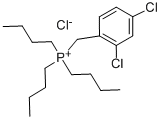
Chlorphonium chloride is an obsolete plant growth regulator that was used largely on ornamentals. It has a high aqueous solubility but is non-volatile. It can be very persistent in soil systems. Little data is available regarding its toxicity to biodiversity. It has a moderate mammalian toxicity and is a skin and eye irritant.
White, crystalline solid; mild aromatic
odor. Technical grade melts at 114–120C. Soluble
in water, acetone, ethanol, isopropanol and hot benzene;
insoluble in hexane and ether.
Growth retardant for ornamental plants.
Chlorphonium chloride is commercially produced in a process that involves the quaternization of tributylphosphine with 2,4-dichlorobenzyl chloride under controlled conditions, typically in an inert solvent like toluene or acetonitrile. The reaction yields the phosphonium salt, which is then purified through crystallisation or solvent extraction.
ChEBI: Chlorphonium chloride is an organic molecular entity.
Systemic. Gibberellin biosynthesis inhibitor
Herbicide; Plant Growth Regulator