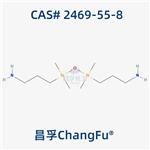
1,3-Bis(3-aminopropyl)tetramethyldisiloxane is a valuable diamino-functional siloxane monomer and modifier. Its unique combination of flexible siloxane backbone and reactive amine groups makes it essential for creating flexible, tough silicones, modifying epoxy resins, synthesizing siloxane-containing polymers (polyamides, polyimides), and enhancing adhesion in various materials applications. Its moisture sensitivity requires careful handling and storage.
Clear colorless to pale yellow liquid
1,3-Bis(3-aminopropyl)tetramethyldisiloxane is an endcapper for the synthesis of aminopropyl-terminated silicone fluids and for the production of silicone-epoxy and silicone polyimide copolymers especially useful in electronics applications. A unique manufacturing process insures that It has only gamma - aminopropyl substitution and none of the beta isomer. This is expected to give better reactivity in copolymer synthesis and improved heat stability.
1,3-Bis(3-aminopropyl)tetramethyldisiloxane is an alkaline material due to its amine reactive groups. Care should be exercised in handling it to prevent contact with skin and eyes. Wear safety glasses with side shields and rubber gloves when handling.
1,3-Bis(aminopropyl)tetramethyldisiloxane is used as a curing agent for epoxy molding compounds, which is utilized for high-reliability semiconductor devices. It is also used to prepare siloxane- urea copymers from 4,4-diphenylmethane diisocyanate.
A glass flask with a stirrer, reflux condenser, thermometer, and dropping funnel was charged with N, N-bis(trimethylsilyl)allylamine. A 4% isopropyl alcohol solution of H2 PtCl6.6H2 O. From the funnel, dimethyl ethoxy silane was added dropwise to the flask at 70° C. over 3 hours for hydrosilylation reaction. The reaction solution was ripened for one hour at the temperature. After adding ethanol and dodecylbenzenesulfonic acidd, the reaction solution was refluxed for 6 hours, completing the desilylation reaction. The reaction solution was transferred to a distillation apparatus where the ethanol and trimethyl ethoxy silane were distilled under atmospheric pressure. Water was added to the remainder, which was refluxed for 2 hours. Vacuum distillation was then carried out to collect 1,3-Bis(3-aminopropyl)tetramethyldisiloxane.
1,3-Bis(3-aminopropyl)tetramethyldisiloxane participate in typical amine reactions: epoxy curing (forming crosslinks), isocyanate reactions (forming ureas), salt formation, Michael additions, condensation reactions, etc. The siloxane Si-O bonds can hydrolyze under acidic or basic conditions.
Flammability and Explosibility
Non flammable
Poison by intraperitoneal route. When heated to decomposition it emits toxic vapors of NOx.