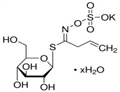
White needle-shaped crystals, soluble in organic solvents such as methanol, ethanol, and DMSO, derived from chili seeds, fried mustard seeds, and mustard seeds.
Sinigrine, is a glucosinolate which is found naturally in Cruciferae including the genus Brassica. When enzymatically hydrolysed, Sinigrine yields isothiocyanates and give a pungent taste. Both Sinigrine, and isothiocyanates, have been shown to have anticancer activity as well as antifungal and antibacterial properties.
Sinigrin, a glucosinolate, is used as a systrate to identify, differentiate and characterize myrosinase(s)/thioglucoside glucohydrolase(s)/thioglucosidase(s). Sinigrin is used as a reference material in procedures for the isolation and identification of glucosinolates.
ChEBI: An alkenylglucosinolate that is the conjugate base of sinigrin.
A β-D-thioglucopyranoside occurring in black mustard seeds and horseradish root. Substrate for thioglucosidase.
Sinigrin (15-30 mg/kg; Oral administration; for 12 days) exerts protective and therapeutic effects on DSSinduced colitis, by enhancing the anti-oxidant enzymes and suppressing the intestinal inflammatory cascade of markers by regulating the MAPK pathway[2].
| Animal Model: | A dextran sulfate sodium (DSS)-induced mouse model[2] |
| Dosage: | 15 mg/kg or 30 mg/kg |
| Administration: | Oral administration; for 12 days |
| Result: | Significantly mitigated the DSS-induced body weight loss, attenuated the colon length shrinkage, and improved the disease index score. Successfully abrogated the DSS-induced IL-17 levels and improved the colonic barrier in colon tissues. |