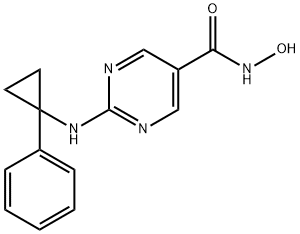
ACY-738 is an inhibitor of histone deacetylase 6 (HDAC6; IC50 = 1.7 nM). It is selective for HDAC6 over HDAC1-3 (IC50s = 94, 128, and 218 nM, respectively). ACY-738 (5 mg/kg) increases acetylation of α-tubulin in mouse brain. It increases exploratory activity in a novel open-field test and reduces immobility time in a tail suspension test in wild-type, but not neural cell-selective HDAC6 knockout, mice when administered at a dose of 50 mg/kg, indicating anxiolytic and antidepressant-like activity, respectively. ACY-738 (100 mg/kg in the diet) attenuates decreases in caudal nerve sensory nerve action potential (SNAP) amplitude and increases in hind paw mechanical hypersensitivity in a mouse model of peripheral neuropathy induced by vincristine . It decreases hepatorenal cystogenesis in a rat model of polycystic liver disease when administered at a dose of 30 mg/kg.
ACY-738 is a potent, selective and orally-bioavailable HDAC6 inhibitor, with an IC50 of 1.7 nM; ACY-738 also inhibits HDAC1, HDAC2, and HDAC3, with IC50s of 94, 128, and 218 nM.
ACY-738 (5mg/kg) leads to significant increase in α-tubulin acetylation in whole-brain lysates. ACY-738 (50mg/kg) fails to produce an enhancement of locomotor activity in WT mice tested in a home cage environment[1]. ACY-738 (5 mg/kg) reaches a maximum plasma concentration of 1310 ng/mL at 0.0830 h following treatment. ACY-738 (5 mg/kg BW) alters BM B cell differentiation, but shows no significant effect on IgG and C3 deposition in NZB/W mice. ACY-738 (20 mg/kg) significantly attenuates the severity of proteinuria in NZB/W F1 mice. ACY-738 (5 mg/kg) shows a significant decrease in anti-dsDNA production in NZB/W mice as they aged. ACY-738 (5, 20 mg/kg) attenuates sera IL-1β production as the NZB/W mice aged. ACY-738 (5 mg/kg) significantly reduces glomerular IL-6 and IL-10 mRNA levels by more than 50% while treatment with 20 mg/kg ACY-738 reduced IL-6 and IL-10 mRNA to non-detectable levels[2].
HDAC6: 1.7 nM (IC50); HDAC1: 94 nM (IC50); HDAC2: 128 nM (IC50); HDAC3: 218 nM (IC50)
[1] Jochems J, et al. Antidepressant-like properties of novel HDAC6-selective inhibitors with improved brain bioavailability. Neuropsychopharmacology. 2014 Jan;39(2):389-400. DOI:
10.1038/npp.2013.207[2] Regna NL, et al. Specific HDAC6 inhibition by ACY-738 reduces SLE pathogenesis in NZB/W mice. Clin Immunol. 2016 Jan;162:58-73. DOI:
10.1016/j.clim.2015.11.007[3] Mithraprabhu S, et al. Histone deacetylase (HDAC) inhibitors as single agents induce multiple myeloma cell death principally through the inhibition of class I HDAC. Br J Haematol. 2013 Aug;162(4):559-62. DOI:
10.1111/bjh.12388