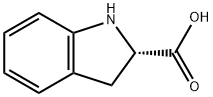
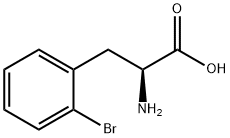
Example 1 Synthesis of (S)-2,3-dihydro-1H-indole-2-carboxylic acid: In a 100 mL flask, 366 mg (1.5 mmol) of (S)-2-bromophenylalanine, 217 mg (1.6 mmol) of K2CO3, 3.2 mg (0.03 mmol) of CuCl, and 3.2 g of N-methyl pyrrolidone (NMP) were added in order. ). The reactor was flushed with argon and kept under a slow flow of argon. The reaction mixture was stirred and heated to 100 °C, which was maintained. Samples were taken periodically and analyzed by high performance liquid chromatography (HPLC). after 4 h, (S)-2-bromophenylalanine was completely converted to the target product. (The yield (in solution) of (S)-2,3-dihydro-1H-indole-2-carboxylic acid was 95.9% with an enantiomeric excess (ee) > 98.6%. Example 2 Synthesis of (S)-2,3-dihydro-1H-indole-2-carboxylic acid: 9.76 g (40.0 mmol) of (S)-2-bromophenylalanine, 5.80 g (42.0 mmol) of K2CO3, 40 mg (0.4 mmol) of CuCl, and 40 g of NMP were sequentially added to a flask at 80 °C. The reactor was flushed with argon and then kept under a slow flow of argon. The reaction mixture was stirred and heated to 80 °C, which was maintained. Samples were taken periodically and analyzed by HPLC. after 3.5 h, (S)-2-bromophenylalanine was completely converted. The reaction mixture was cooled to 25 °C, followed by the addition of 40 mL of water and 50 mL of ethyl acetate (EtOAc). The pH of the mixture was adjusted to 3.3 with 3.5 g of a 37% aqueous hydrochloric acid solution. after separation of the phases, the aqueous phase was extracted with 2 x 50 mL of EtOAc. The combined organic layers were washed with 25 mL of saturated aqueous sodium chloride and the organic phase was subsequently concentrated. The residue was dissolved in 16 mL of aqueous 5N hydrochloric acid, and the pH was adjusted to 2.1 with 9.4 g of 32% aqueous sodium hydroxide. the precipitated (S)-2,3-dihydro-1H-indole-2-carboxylic acid was separated by filtration and washed with 2 x 10 mL of water. After drying, 3.24 g (19.8 mmol) of (S)-2,3-dihydro-1H-indole-2-carboxylic acid was obtained in 49.5% yield, ee > 99%.