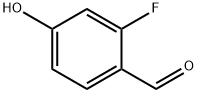
2-Fluoro-4-hydroxybenzaldehyde is mainly used as an intermediate for physiologically active compounds such as pharmaceuticals or pesticides and is a wide range of organic building blocks. Its structure contains fluorine, aldehyde groups, and phenolic hydroxyl groups, and these groups can add or replace other functional groups.
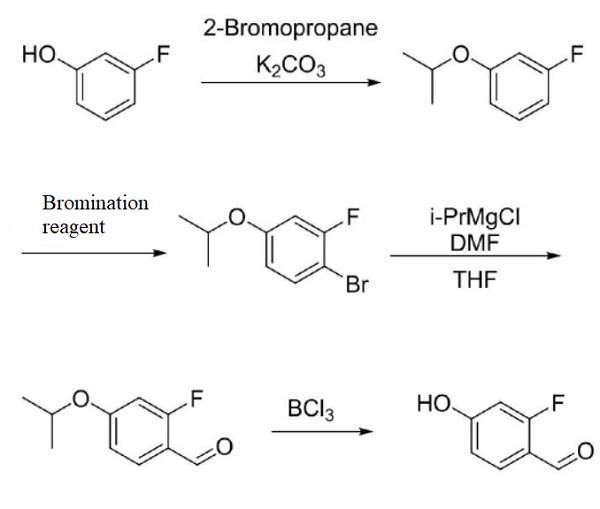
Preparation of 2-fluoro-4-hydroxybenzaldehyde involves: (1) mixing 3-fluorophenol (I), potassium carbonate, and 2-bromopropane in an organic solvent, and heating to react to obtain 1-fluoro-3-isopropoxybenzene (II); (2) dissolving compound (II) in an organic solvent and reacting with a brominating reagent to obtain 1-bromo-2-fluoro-4-isopropoxybenzene (III); (3) dissolving compound (III) in tetrahydrofuran, dripping isopropylmagnesium chloride/tetrahydrofuran solution at -10°C to 0°C, adding dimethylformamide to react after Grignard exchange to obtain 2-fluoro-4-isopropoxybenzaldehyde (IV); and (4) reacting compound (IV) with boron trichloride and deprotecting.
[1] Patent: US2011/98251, 2011, A1. Location in patent: Page/Page column 67-68
[2] Chemistry Letters, 2008, vol. 37, # 4, p. 436 - 437
[3] Patent: WO2007/14895, 2007, A2. Location in patent: Page/Page column 30; 31
[4] Patent: WO2008/87198, 2008, A1. Location in patent: Page/Page column 44-45
[5] Patent: WO2010/102154, 2010, A2. Location in patent: Page/Page column 55