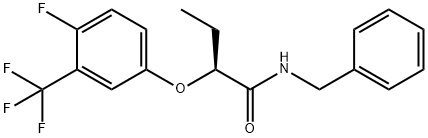
Beflubutamid-M is the S-enantiomer of chiral beflubutamide and considered to demonstrate the most herbicidal activity of the two isomers. It has a low aqueous solubility and a low volatility. It may be persistent in soils depending upon local conditions. Risk of leaching, based on its physicochemical properties, is considered low. Its toxicity to biodiversity is low with the exception of earthworms and aquatic species where its toxicity is classified as moderate. It has a low oral mammalian toxicity but there are concerns regarding its status as a reproduction/developmental toxicant.
Beflubutamid-M is a herbicide.
ChEBI: (S)-beflubutamid is an N-benzyl-2-[4-fluoro-3-(trifluoromethyl)phenoxy]butanamide that has S configuration. It is an enantiomer of a (R)-beflubutamid.
Beflubetamid-M production starts with the production of beflubetamid racemic mixture through a synthetic chemical process involving the condensation of 2-[4-fluoro-3-(trifluoromethyl)phenoxy]butyric acid with benzylamine, forming the herbicidal compound N-benzyl-2-[4-fluoro-3-(trifluoromethyl)phenoxy]butanamide. Beflubetamid-M is isolated from the racemic mixture, which contains both R- and S-enantiomers. through chiral resolution techniques, such as crystallisation with chiral agents or chromatographic separation. The S-enantiomer, known as beflubetamid-M, is subsequently purified due to its superior herbicidal efficacy.
Substance is translocated in plants. Bleaching - Carotenoid biosynthesis inhibitor.