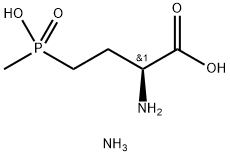
Glufosinate-P-ammonium is a herbicide for control of a wide range of weeds. It is highly soluble in water, volatile and has a low risk of leaching to groundwater. It is non-persistent in soils but may be persistent in aquatic systems. It is moderately toxic to mammals and considered to be a neurotoxin. It shows a moderate to low toxicity to birds, most aquatic organisms, earthworms and honeybees.
Glufosinate P Ammonium Salt is a useful reagent for study of rabbit serum cross-reactivity in derivatization-assisted immunoassay of glufosinate, using the target analyte N-acetylglufosinate.
The production of glufosinate-P-ammonium involves a multistage synthesis that begins with the creation of a phosphorus intermediate, typically through the reaction of methylphosphonite with acrolein. This intermediate undergoes a Strecker reaction, or an alternative cyclisation like Bucherer-Bergs, using cyanide compounds (sodium cyanide/ammonium chloride) and ammonia in an aqueous solvent to form an amino-nitrile intermediate. This intermediate is then subjected to hydrolysis under acidic conditions (using hydrochloric acid) at high temperatures to produce glufosinate acid. Finally, the glufosinate acid is neutralised with ammonia gas or ammonium hydroxide in a solvent (such as alcohol), followed by crystallisation, filtration, and drying to yield the final high-purity, active L-isomer. For "glufosinate-P" (the L-isomer), a chiral resolution step or asymmetric synthesis is typically required to ensure high enantiomeric purity, often replacing the racemic mixture.
Non-selective, contact with some systemic action. Glutamine synthetase inhibitor: accumulates ammonium ions, inhibits photosynthesis.