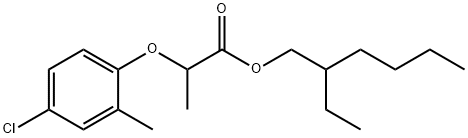
Mecoprop-etexyl is produced through an industrial sequence centred on preparing the phenoxypropionic acid core and converting it into a stable ester with 2-ethylhexanol. Manufacturing generally begins with synthesis of racemic mecoprop acid, typically via chlorination of the corresponding phenoxypropionate precursor followed by hydrolysis, or by direct condensation routes used across the phenoxy herbicide family. The acid is then transformed into a more reactive derivative, most commonly an acid chloride, under controlled conditions to prevent side reactions. This activated intermediate is reacted with 2-ethylhexanol to form the etexyl ester, with catalysts and solvents selected to drive the esterification efficiently.