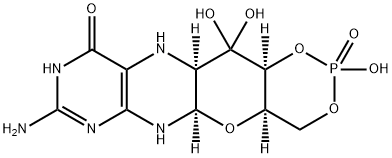
Fosdenopterin is synthesized from D-galactose in a two-step reaction:
Step 1: Preparation of the nucleus (11.5) of fosdenopterin: D-galactose (11.1, Fig. 1) is treated to obtain galactose phenylhydrazine 11.2, which is in equilibrium with its tautomer 11.3. This key starting material is used to react with 2,5,6-triamino-3,4-dihydropyrimidone 11.4 in methanol/water by heating (110°C) to rapidly synthesize the nucleus structure 11.5 as a single isomer (yield 36%). It is noteworthy that in this reaction process, the conversion of 11.2 to 11.3 is believed to be initially achieved through the Amadori rearrangement of phenylhydrazone, followed by regioselective condensation with the most basic amino group (5-NH2) in 11.4, and further through intramolecular addition reaction of the C5 hydroxyl group in galactose and the formation of pyran.

Step 2: Synthesis of Fosdenopterin hydrochloride: To avoid oxidation of the advanced intermediate 11.5 to its corresponding aromatic pteridine derivative, a method of protecting N10 was adopted (Fig. 2). Therefore, 11.5 was reacted with an excess of Boc anhydride (9 equivalents) and DMAP in THF to obtain a series of products containing different degrees of Boc protection, including intermediates 11.6 and 11.7 (seven-fold and six-fold Boc protection, respectively). However, 11.6 was found to have limited stability, and 11.6 was simply treated with silica gel to obtain the six-fold protected intermediate 11.7. Based on this, 11.6 and 11.7 can be converted to the triply Boc-amine protected intermediate 11.8 by adding a precisely controlled amount of sodium methoxide in MeOH, followed by post-treatment with acidic Dowex resin. Treatment of 11.8 with methyl dichlorophosphate and pyridine in DCM gave the desired phosphate ester 11.9. The final steps of the synthesis involved Swern oxidation of the secondary alcohol, hydrate formation from the resulting ketone, and subsequent overall deprotection. Since the hydrate was unstable after workup, this crude intermediate was immediately treated with trimethylsilyl bromide in aqueous acetone to complete the deprotection of the amine and phosphate and afford 11 by crystallization. 11 was recrystallized from aqueous hydrobromic acid/isopropanol to afford fosdenopterin monobromide dihydrate with a purity of 95%.