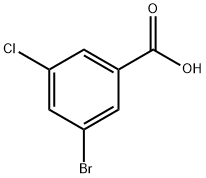
Preparation of 3-bromo-5-chlorobenzoic acid (diazotization, diazonium salt conversion)
In a 250 mL four-necked flask equipped with a thermometer, dropping funnel, and reflux condenser, 11.2 g (0.045 mol) of 2-amino-3-bromo-5-chlorobenzoic acid and 12 mL of 98% concentrated sulfuric acid were added sequentially. After stirring and dissolving, 5.4 g of 30% sodium nitrite aqueous solution was slowly added dropwise while controlling the reaction temperature at 10℃. After the addition was completed, the reaction was kept at this temperature for 1 h. In another 250 mL four-necked flask equipped with a thermometer and reflux condenser, 2.4 g (0.04 mol) of copper powder and 50 mL of ethanol were added. The above reaction solution was added dropwise under reflux, and the addition was completed within 30 min. Reflux was continued for 1 h. After slightly cooling, the reaction apparatus was changed to a distillation apparatus to distill and recover most of the ethanol. After cooling, the reaction solution was poured into ice water, and 9.8 g of yellow solid precipitated.
Recrystallization from anhydrous ethanol yielded 7.2g of white 3-bromo-5-chlorobenzoic acid crystals (purity 99.6%) with a melting range of 190.0–192.0℃ (literature value [1] 189–190℃), and a total yield of 41.7% (based on 2-amino-3-bromo-5-chlorobenzoic acid). Maintaining the holding time unchanged, appropriately increasing the temperature of the diazotization reaction helps to increase the product yield. However, when the temperature is further increased to 10℃, the product yield decreases instead. This is because the diazotization reaction is an electrophilic substitution reaction. 2-amino-3-bromobenzoic acid is relatively weak, and appropriately increasing the temperature can accelerate the diazotization reaction rate. However, excessively high reaction temperatures will cause nitrous acid and diazonium salts to decompose, which in turn decreases the product yield. Therefore, the suitable diazotization reaction temperature is 5℃.