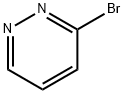
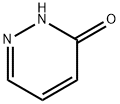
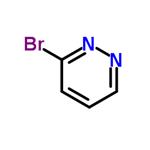
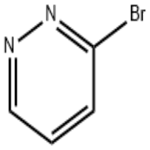
Synthesis of 3-bromopyridazine: Bromophosphorus oxide (158 g, 552 mmol) was placed under mechanical stirring and heated to 80 °C until completely molten. Subsequently, 3-hydroxypyridazine (30.5 g, 317 mmol) was added to the molten phosphorus bromide in a single step, and the color of the reaction mixture rapidly changed from orange to yellow, and eventually formed a black solid. The reaction system was heated up to 120 °C and maintained at this temperature for 3 hours. Upon completion of the reaction, the reaction mixture was cooled to room temperature, followed by further cooling in an ice water bath. Ice water (total 300 mL) was added slowly, taking care to control the rate of addition to mitigate the exothermic phenomenon (white smoke generation was observed). During stirring, some of the solids were not dissolved, at which point 2M NaOH aqueous solution (180 mL) was added and stirring was continued for 45 minutes until all solids were completely dissolved. The resulting dark red/brown solution was slowly poured into a pre-cooled ice/water bath containing 2M NaOH aqueous solution (910 mL), keeping the internal temperature below 25°C. The solution was then mixed with 2M NaOH aqueous solution (910 mL). The pH of the solution was adjusted to about 9.5 with 2M NaOH aqueous solution (50 mL).The solution was extracted using dichloromethane (DCM, 5 x 250 mL) and the yellow organic layers were combined, dried with anhydrous sodium sulfate (Na2SO4), filtered and concentrated in vacuum to give a gray/brown solid crude product. The crude product was adsorbed on silica (98 g) and purified by silica gel column (200 g) using heptane/ethyl acetate (1:1) as eluent. Fractions containing the target product were collected, combined and concentrated in vacuum to afford 3-bromopyridazine (34.7 g, 216 mmol, 69% yield) as a green/gray solid.GCMS analysis showed product purity >99%.