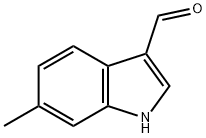
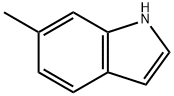
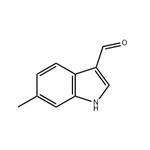
6-Methylindole-3-carboxaldehyde is an indole compound that can be prepared by the C3-formylation of indole with formaldehyde and ammonia catalysed by iron in air. The substance can also be used to prepare other nitrogen-containing heterocyclic compounds, which are widely used in chemical manufacturing, medicine, dyes and luminescent materials.
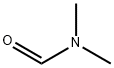
The general procedure for the synthesis of 6-methylindole-3-carbaldehyde from 6-methylindole and N,N-dimethylformamide is as follows:
1. Synthesis of indole derivatives
1) Synthesis of 3-cyanoindole derivatives
Formylation of the 3-position of the corresponding indole was carried out in dimethylformamide (using Vilsmeier's method) using phosphorus trichloride. Subsequently, nine 6-methylindole-3-carboxaldehydes were prepared by cyanidation achieved by dehydration reaction with hydroxylamine in sodium formate and formic acid. Next, the coupling reaction with ethyl 4-fluorobenzoate was carried out in a dimethyl sulfoxide solution of potassium fluoride, amino acids and 18-crown-6-ether. Finally, hydrolysis was carried out with lithium hydroxide, completing a total of 4 steps of reaction.
2) Preparation of XO-CH172 and XO-CH183 (R is 2-methyl or 5-methoxy, respectively) from step (2) using commercially available corresponding aldehydes.
1) Synthesis of XO-CH200
Under argon protection, 6-methylindole (1.004 g, 7.62 mmol) was dissolved in dimethylformamide (10 mL), and phosphorus trichloride (2 mL) was slowly added to this solution under ice bath cooling. The reaction mixture was stirred at room temperature for 1.5 hours. An aqueous sodium hydroxide solution (5 g/15 mL) was added dropwise to the reaction mixture under ice bath cooling. Subsequently, the mixture was heated to reflux for 1.5 hours. Cooled again in an ice bath, water was added to the reaction mixture and the pH was adjusted to 3 with concentrated hydrochloric acid. the solid product was collected by filtration and dried under reduced pressure at 60 °C to give XO-CH180 in light brown solid form (1.14 g, 94% yield).
[1] Journal of Agricultural and Food Chemistry, 2013, vol. 61, # 24, p. 5696 - 5705
[2] Patent: EP1932833, 2008, A1. Location in patent: Page/Page column 15; 19
[3] Chemical Biology and Drug Design, 2011, vol. 78, # 5, p. 864 - 868
[4] European Journal of Medicinal Chemistry, 2015, vol. 92, p. 776 - 783
[5] Bioorganic and Medicinal Chemistry Letters, 2003, vol. 13, # 7, p. 1301 - 1305