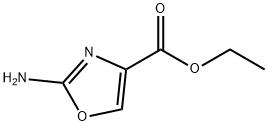
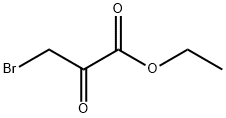
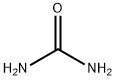
General procedure for the synthesis of ethyl 2-aminooxazole-4-carboxylate from ethyl 3-bromopyruvate and urea: ethyl 3-bromopyruvate (50.2 g, 257.2 mmol) was dissolved in ethanol and urea (23.2 g, 385.8 mmol) was added with stirring. The reaction mixture was heated to reflux overnight. After completion of the reaction, the solvent was removed by concentration under reduced pressure. The obtained residue was dissolved in a solvent mixture of ethyl acetate and water to separate the organic and aqueous layers. The aqueous layer was extracted with ethyl acetate. All organic layers were combined, washed sequentially with saturated sodium chloride solution and dried over anhydrous magnesium sulfate. After filtration, the organic phase was concentrated under reduced pressure to afford the target product ethyl 2-aminooxazole-4-carboxylate in 85% yield. The structure of the product was confirmed by nuclear magnetic resonance (NMR) and mass spectrometry (MS) analyses.LCMS (ESI+) m/z: 157.1 ([M+H]+).
[1] Patent: US2009/23707, 2009, A1. Location in patent: Page/Page column 33-34
[2] Patent: WO2017/17631, 2017, A2. Location in patent: Paragraph 00382
[3] European Journal of Medicinal Chemistry, 2019, p. 80 - 108
[4] Patent: WO2007/146066, 2007, A2. Location in patent: Page/Page column 156-157
[5] Journal of Medicinal Chemistry, 2010, vol. 53, # 9, p. 3814 - 3830