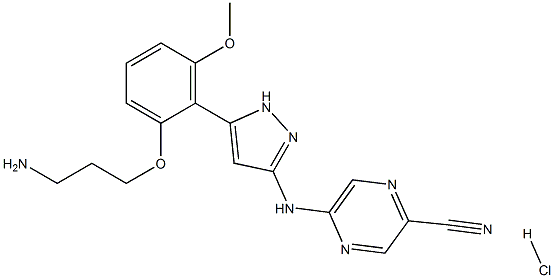
Prexasertib HCl is a member of the serine/threonine protein kinase family and is the core protein of cell cycle checkpoints in DNA damage response (DDR).
Prexasertib dihydrochloride (LY2606368 dihydrochloride) is a selective, ATP-competitive second-generation checkpoint kinase 1 (CHK1) inhibitor with a Ki of 0.9 nM and an IC50 of <1 nM. Prexasertib dihydrochloride inhibits CHK2 (IC50=8 nM) and RSK1 (IC50=9 nM). Prexasertib dihydrochloride causes double-stranded DNA breakage and replication catastrophe resulting in apoptosis. Prexasertib dihydrochloride shows potent anti-tumor activity[1][2].
Prexasertib HCl is an ATP-competitive inhibitor of CHK1 with a Ki value of 0.9 nM. In cell-free experiments, the IC50 values of it for CHK2 and RSK were 8 nM and 9 nM, respectively.
Prexasertib dihydrochloride (LY2606368 dihydrochloride; 1-10 mg/kg; SC; twice daily for 3 days, rest 4 days; for three cycles) causes growth inhibition in tumor xenografts[1].
Prexasertib dihydrochloride (15 mg/kg; SC) causes CHK1 inhibition in the blood and the phosphorylation of both H2AX (S139) and RPA2 (S4/S8)[1].
| Animal Model: | Female CD-1 nu-/nu- mice (26-28 g) with Calu-6 cells[1] |
| Dosage: | 1, 3.3, or 10 mg/kg |
| Administration: | SC; twice daily for 3 days, rest 4 days; for three cycles |
| Result: | Caused statistically significant tumor growth inhibition (up to 72.3%).
|
| Animal Model: | Female CD-1 nu-/nu- mice (26-28 g) with Calu-6 cells[1] |
| Dosage: | 15 mg/kg (Pharmacokinetic Analysis) |
| Administration: | SC (200 μL) |
| Result: | CHK1 was 7 ng/mL at 12 hours and 3 ng/mL by 24 hours in plasma exposures.
Phosphorylation of both H2AX (S139) and RPA2 (S4/S8) was detectable at 4 hours, showing the rapid occurrence of DNA damage.
|
| Target | Value |
Chk1
(Cell-free assay) | 0.9 nM(Ki) |
Chk2
(Cell-free assay) | 8 nM |
< tr> RSK
(Cell-free assay) | 9 nM |
Chk1: 0.9 nM (Ki); Chk1: <1 nM (IC50); Chk2: 8 nM (IC50)
[1] King C, et al. LY2606368 Causes Replication Catastrophe and Antitumor Effects through CHK1-Dependent Mechanisms. Mol Cancer Ther. 2015 Sep;14(9):2004-1 DOI:
10.1158/1535-7163.MCT-14-1037[2] Yin Y, et al. Chk1 inhibition potentiates the therapeutic efficacy of PARP inhibitor BMN673 in gastric cancer. Am J Cancer Res. 2017 Mar 1;7(3):473-483. PMID:28401005