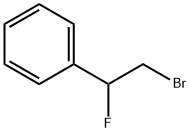
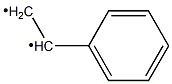
The general procedure for the synthesis of (2-bromo-1-fluoro)ethylbenzene from the compound (CAS: 292638-84-7) was as follows: the reaction was carried out in a plastic vial. N-bromosuccinimide (NBS, 53.4 mg, 0.3 mmol) and olefin (0.20 mmol) were dissolved in dichloromethane (CH2Cl2, 1 mL) followed by addition of DMPU/HF (41.2 μL, 1.4 mmol). The reaction mixture was stirred at room temperature for 24 hours. Upon completion of the reaction, the reaction was quenched by the addition of water (2 mL) and the mixture was extracted with dichloromethane (3 x 2 mL). The organic layers were combined, dried over anhydrous sodium sulfate (Na2SO4) and concentrated under reduced pressure to remove the solvent. In some cases, purification by rapid chromatography on silica gel (SiO2) (eluent ratio 9:1 hexane/ethyl acetate) yields a mixture of bromofluorine compounds as regional isomers. The structure of (2-bromo-1-fluoroethyl)benzene (2a) was confirmed by nuclear magnetic resonance hydrogen spectroscopy (1H NMR, 400 MHz, CDCl3) and fluorine spectroscopy (19F NMR, 376 MHz, CDCl3) with the following data: 1H NMR δ 7.50 (m, 5H), 5.60 (dd, J = 47.1, 7.8, 4.1 Hz, 1H). 3.66 (ddd, J = 15.3, 11.3, 7.8 Hz, 1H), 3.58 (ddd, J = 26.0, 11.3, 4.2 Hz, 1H); 19F NMR δ -175.0 (m). The product was a colorless oil.