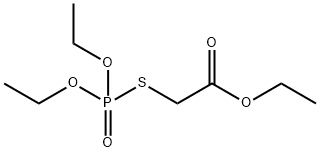
Acetophos is produced through an industrial process built around assembling its phosphorothioate core and attaching the appropriate substituted phenyl and alkoxy groups while keeping sulphur-based impurities under control. Commercial manufacture typically begins with preparation of the substituted phenol component, followed by controlled halogenation or activation to make it suitable for coupling. In a parallel stream, the phosphorothiochloridate intermediate is generated under moisture-free conditions, since both the phosphorus-sulphur bond and the acid chloride functionality are highly sensitive to hydrolysis. The key production step is esterification: the activated phosphorus intermediate is reacted with the phenolic component in the presence of a base that neutralises the released hydrogen chloride and limits side reactions. Downstream operations focus on solvent removal, phase separation, and multi-stage purification to meet agrochemical specifications.